
Four Days that Reframed What’s Possible in AI for Medicine
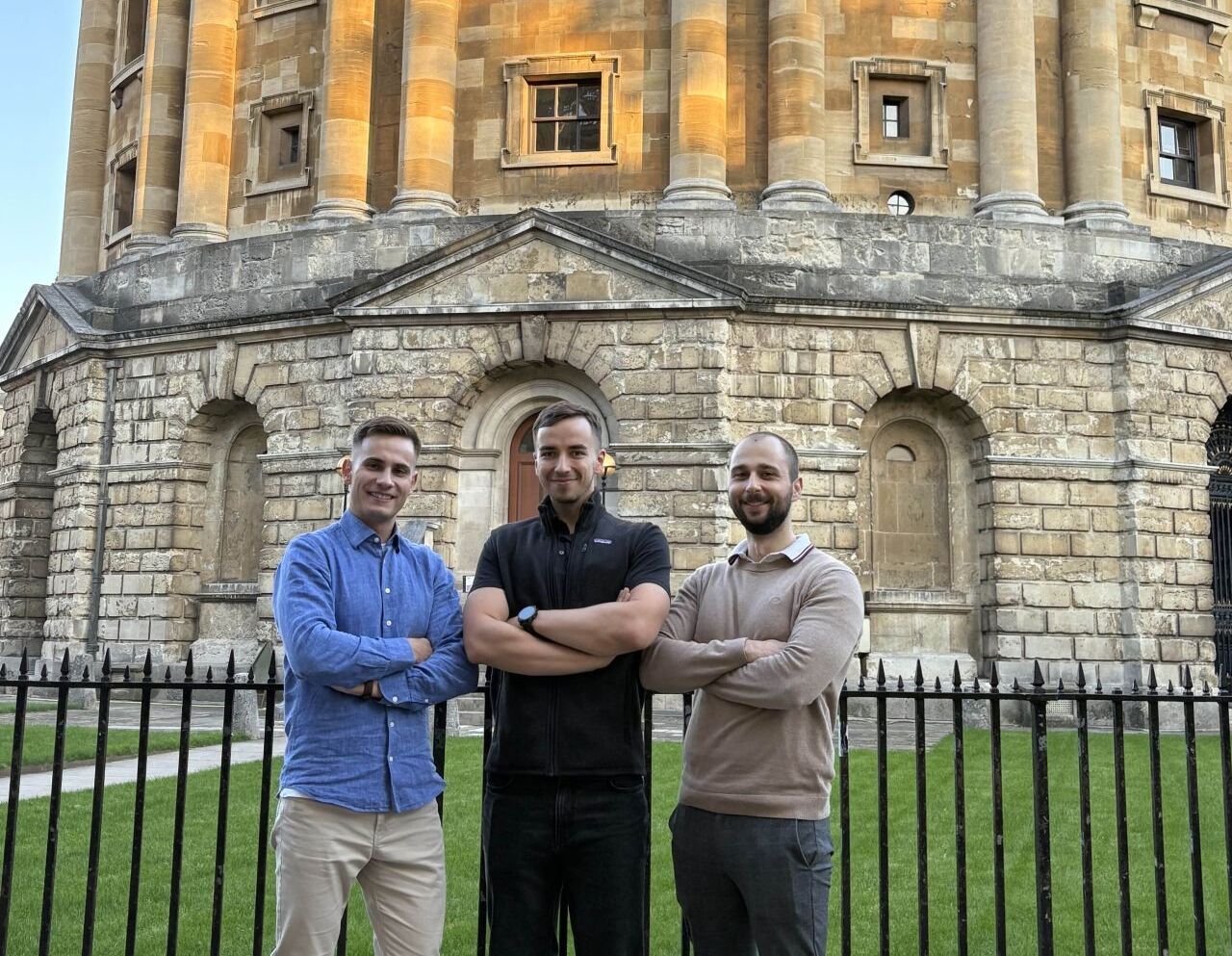
From 2–5 August 2025 at Oxford’s Mathematical Institute, MLx Health & Bio gathered a remarkable mix of researchers, clinicians, and builders to push forward what AI can do in health and biomedicine. The program balanced rigorous theory with hands-on practice across imaging, genomics, EHR, population health, drug discovery, and multi-omics. What stood out most was the density of ideas that traveled well from lab to clinic, and the community’s clear focus on safety, explainability, and real-world deployment.
The speaker and attendee roster read like a cross-section of the field’s leading edge. University of Oxford, University of Cambridge, UCL, King’s College London, Stanford University, University of Toronto, Google DeepMind, Microsoft for Healthcare, Meta, Hugging Face, UK Biobank, and AITHYRA.
The days were packed, and we were fortunate to also be able to deepen relationships, open collaboration threads, and identify concrete ways to translate state-of-the-art research into impact.
A sincere thank-you to the Faculty of Informatics and Information Technologies at the Slovak University of Technology for supporting our participation. It’s energizing to see Central Europe invest in AI talent with an eye on translational medicine, and we’re proud to be part of that momentum. And hats off to AI for Global Goals and partners for orchestrating a world-class gathering that makes collaboration not just likely, but inevitable.
Two talks, in particular, crystallized the event’s themes and directly shape our roadmap.
1. Vivek Natarajan of Google DeepMind
Natarajan’s thesis is deceptively simple. Foundation models are necessary, but not sufficient. The frontier is not just bigger models. It is systems that can reason over long horizons, argue with themselves, and self-improve. The “AI co‑scientist” is a multi‑agent setup that generates hypotheses, mines literature, runs structured debates, reflects on failure modes, and tightens proposals with deep verification steps. It’s the scientific method made computational and iterative.
The results were compelling and concrete. In genetics, earlier Med‑PaLM/Med‑Gemini work surfaced causal variants in mice and humans, later buttressed by CRISPR and AlphaFold. In target discovery and repurposing, the system proposed plausible AML strategies and a novel anti‑fibrotic approach with organoid validation. The most striking vignette recapitulated a decade-long antimicrobial resistance insight in two days, an anecdote, yes, but a powerful signal of what structured, debate‑driven hypothesis generation can unlock.
Equally important was the “co‑physician” thread. AMIE, trained in self‑play and simulation, outperformed primary care physicians on most axes in randomized diagnostic dialogue studies and improved clinician accuracy as an assistive tool. It now reaches beyond differential diagnosis into guideline‑compliant management plans, prescriptions, multi‑visit care, and multimodal reasoning across images, ECGs, and clinical documents. The governance piece is thoughtful. Intake is separated from decision‑making, with a clinician cockpit for rapid review and sign‑off, plus virtual trials showing higher-quality notes and decisions with less time burden. Real-world validation is underway at Beth Israel Deaconess, exactly the sort of stepwise translation the field needs.
2. Zeyu Gao of the University of Cambridge
Gao’s talk was a masterclass in how to build multimodal systems that truly add up to more than the sum of their parts. The starting point is familiar. Early, late, and intermediate fusion still matter, but the upgrades are where the useful gains appear. These include co‑attention between histology and pathway signals, information‑theoretic objectives to disentangle shared vs. modality‑specific information, and architectures that stay robust when a modality is missing at inference.
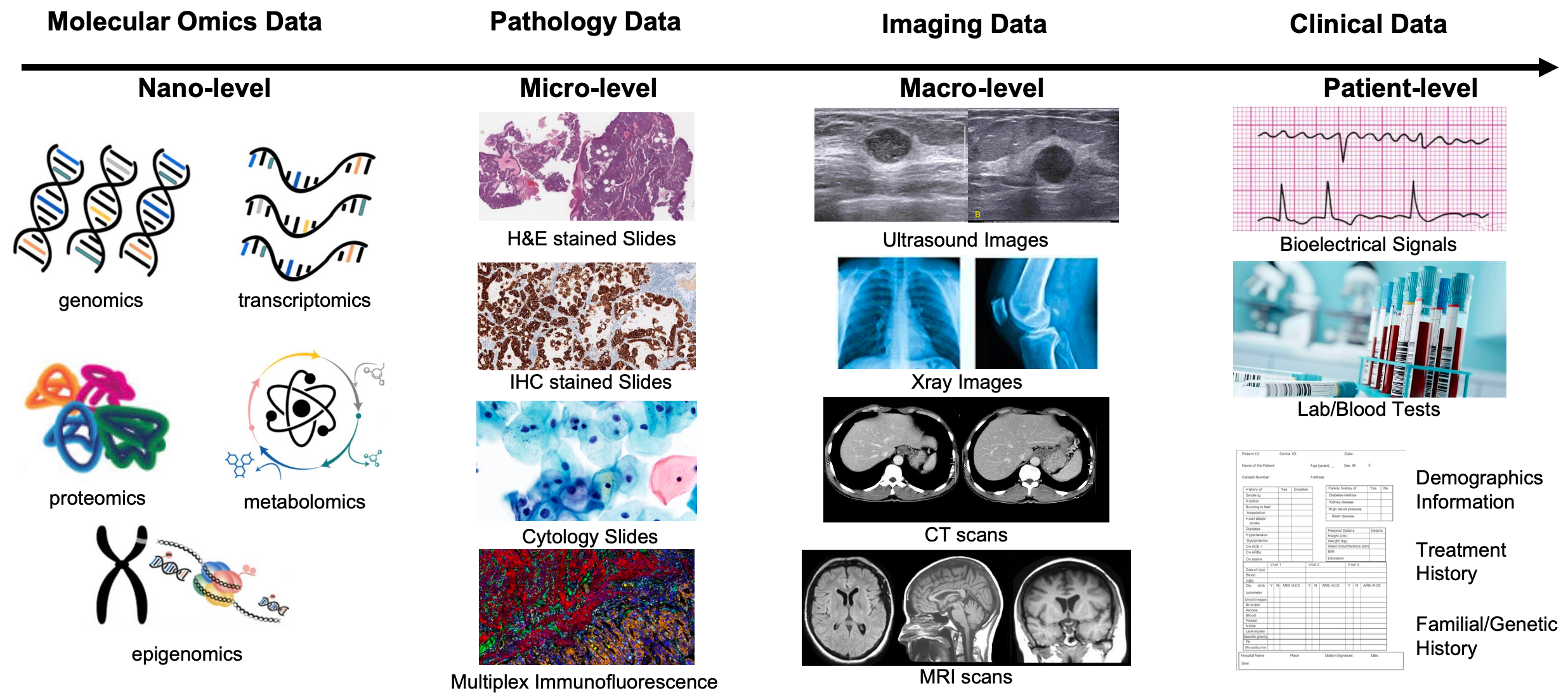
The case studies spanned the cancer continuum. In breast cancer, combining clinical, imaging, and molecular features lifted neoadjuvant response prediction and generalized in external validation. In high‑grade serous ovarian cancer, radiogenomics plus ctDNA sharpened chemotherapy response modeling, while foundation‑model‑driven fusion improved prognostics across cohorts. Renal cell carcinoma showcased dynamic monitoring, with imaging, immune, and cytokine panels tracking real-time response to axitinib with strong AUCs. For immunotherapy in NSCLC, tri‑modal models (radiology, pathology, genomics) outperformed unimodal baselines on PD‑(L)1 response. Woven throughout was a pragmatic message. Strong unimodal encoders matter. Whether it’s Merlin for CT, scGPT/scFoundation for single‑cell, or pathology encoders like TITAN/CONCH/UNI/GigaPath, better foundations reduce data needs and boost generalization.
The “beyond fusion” section pushed further into cross‑modal pretraining and generation. Pathology vision‑language models bring descriptive and reasoning capabilities into the slide viewer. Virtual staining reconstructs histology from label‑free imaging. Histology to transcriptomics predicts spatial gene expression. Prompt‑guided, dual‑scale graph methods close the gap between bench methods and clinic needs (imputation, local‑to‑global prediction, and super‑resolution of gene maps). The payoff is not just accuracy. It is interpretability. Pathway‑aware attention and spatial visualizations yield explanations clinicians can trust.
How OxML Moves Our Roadmap Forward
OxML clarified our strategy on three fronts. First, “beyond fusion” is the right target, and modalities should be treated as interacting views, not just features to concatenate. Second, foundation encoders are leverage. Choose them well to cut data requirements and improve out‑of‑distribution behavior. Third, governance and UX matter as much as model quality. A clinician‑centered cockpit, clear guardrails, and rapid review flows are essential for trust, safety, and adoption.
The biggest takeaway from MLx Health & Bio 2025? The field is converging on a vision that is multimodal, agentic, and explainable. With the right systems, teams, and guardrails, that vision is now execution-ready. OxML gave us the frameworks, the playbooks, and the partners to make it real, and we’re already putting them to work.
A Little Remark On Oxford
Oxford has a charming way of making the past feel present. You can wander from the 18th‑century Radcliffe Camera to a modern lab in minutes, pass the Eagle and Child pub where Tolkien and C.S. Lewis workshopped Middle‑earth and Narnia, and end up punting on the Cherwell if the weather smiles.
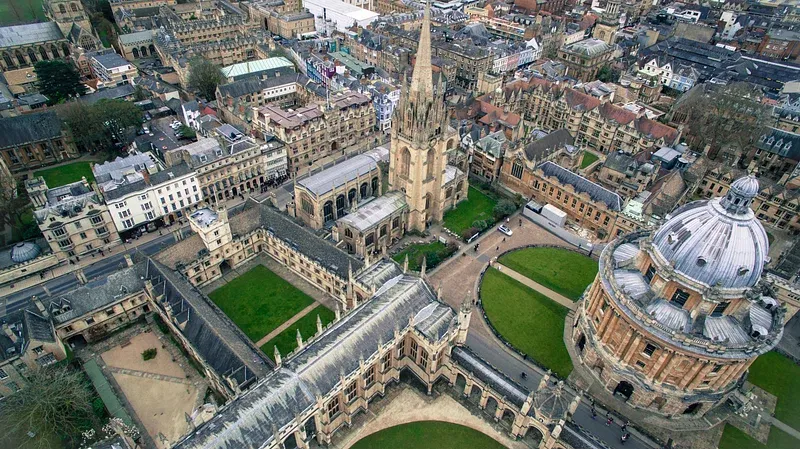
The University of Oxford is widely regarded as the oldest university in the English‑speaking world, with teaching traced to the late 11th–12th century. Its distinctive collegiate system, nearly 40 self‑governing colleges, still shapes student life with formal halls, gowns, and friendly rivalry. Oxford’s libraries hold millions of volumes, led by the Bodleian, which has served scholars continuously since 1602 and requires readers to take a centuries‑old oath. Its museums are just as storied, from the Ashmolean, often cited as the world’s first university museum, to the Museum of Natural History where the famed 1860 Darwin–Wilberforce debate took place. The city’s nicknames tell their own story. “The city of dreaming spires” comes from poet Matthew Arnold, and its streets hide playful traditions, like May Morning singing from Magdalen Tower at dawn and the occasional mishap of a novice punter losing the pole to the riverbed. Despite all the heritage, Oxford hums with new ideas, pairing medieval quadrangles with breakthroughs in AI, medicine, and physics, proof that curiosity here is a very renewable resource.
Gao, Z. (2025). Multimodal and multiomics in cancer research. Fusion, and beyond Conference presentation slides. OxML MLx Health & Bio 2025.
Photo credit, -wuppertaler, “ENG Oxford Woodstock Road 08,” Wikimedia Commons, licensed under CC BY-SA 4.0.